
The counterfeiters
The Vendée, Gaza and false coin

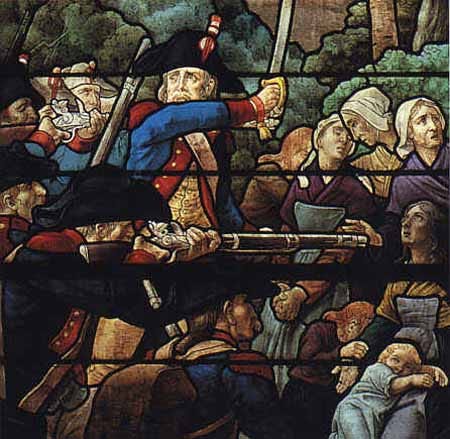
From 1944 to 1986, it seemingly did not occur to anybody to describe the War in the Vendée as a genocide. That is to say, 42 years elapsed from Raphael Lemkin’s coining of the term to its application to this most gruesome episode of the French Revolution.
This is a curious fact, especially when we consider that the association between genocide and the Vendée has firmly entered the discourse around the war and altered how it is viewed.
It is equally noteworthy that the historian who effected this transformation in perceptions of the war is an obscure pariah whose incipient academic career was effectively closed off because of his controversial thesis.
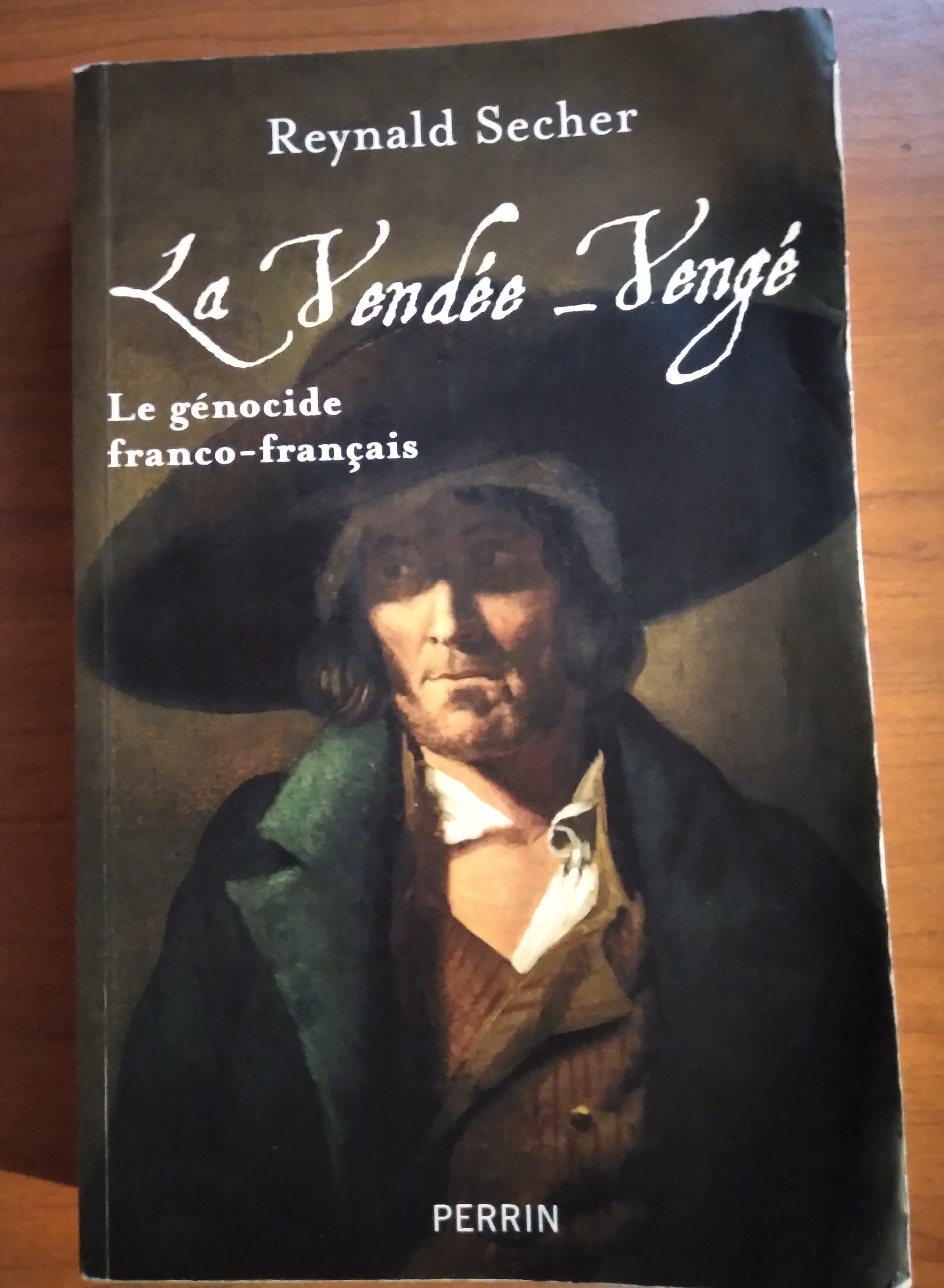
Reynald Secher’s book La Vendée-Vengé: Le génocide franco-français appeared three years before the bicentenary of the Revolution, as the French Republic was gearing up to celebrate its founding. The scholarly work, which was based on Secher’s doctoral thesis, provoked a media storm and a wave of rebuttals.
It is hardly surprising that Secher’s claim was so hotly disputed. There is a great deal at stake. No nation wants a genocide at its foundation. Proponents of radical social change do not want mass murder at the birth of the revolutionary project. And idealists are loath to acknowledge that visiting enlightened dreams on the benighted leads not to liberty, but to oppression; not to fraternity, but to fratricide. Hence the vehement denial that the horrific excesses of twentieth-century totalitarianism might have been spawned in the marshes of the Vendée and the fever-dreams of the Mountain1.
The Vendée is thus a polemical ‘genocide’. (We must retain the scare quotes until we judge the case on its merits.) It pits left-wing and mainstream historians against a right-wing outcast who might well be suspected of having Catholic, royalist and regionalist2 sympathies.
It occurred to me to compare the Vendéan controversy to the accusations of genocide in Gaza. In looking at the arguments Secher uses to build his case, and the arguments of his critics, we get to eavesdrop on how people talk about genocide when Israel is not in the dock.
The contrast with Gaza is interesting in multiple dimensions. We have a right-wing accusation of genocide versus a (predominantly) left-wing one. We have the first modern ‘genocide’ and the latest one. And we have a ‘genocide’ that was asserted long after the fact against one that was alleged long before it.3
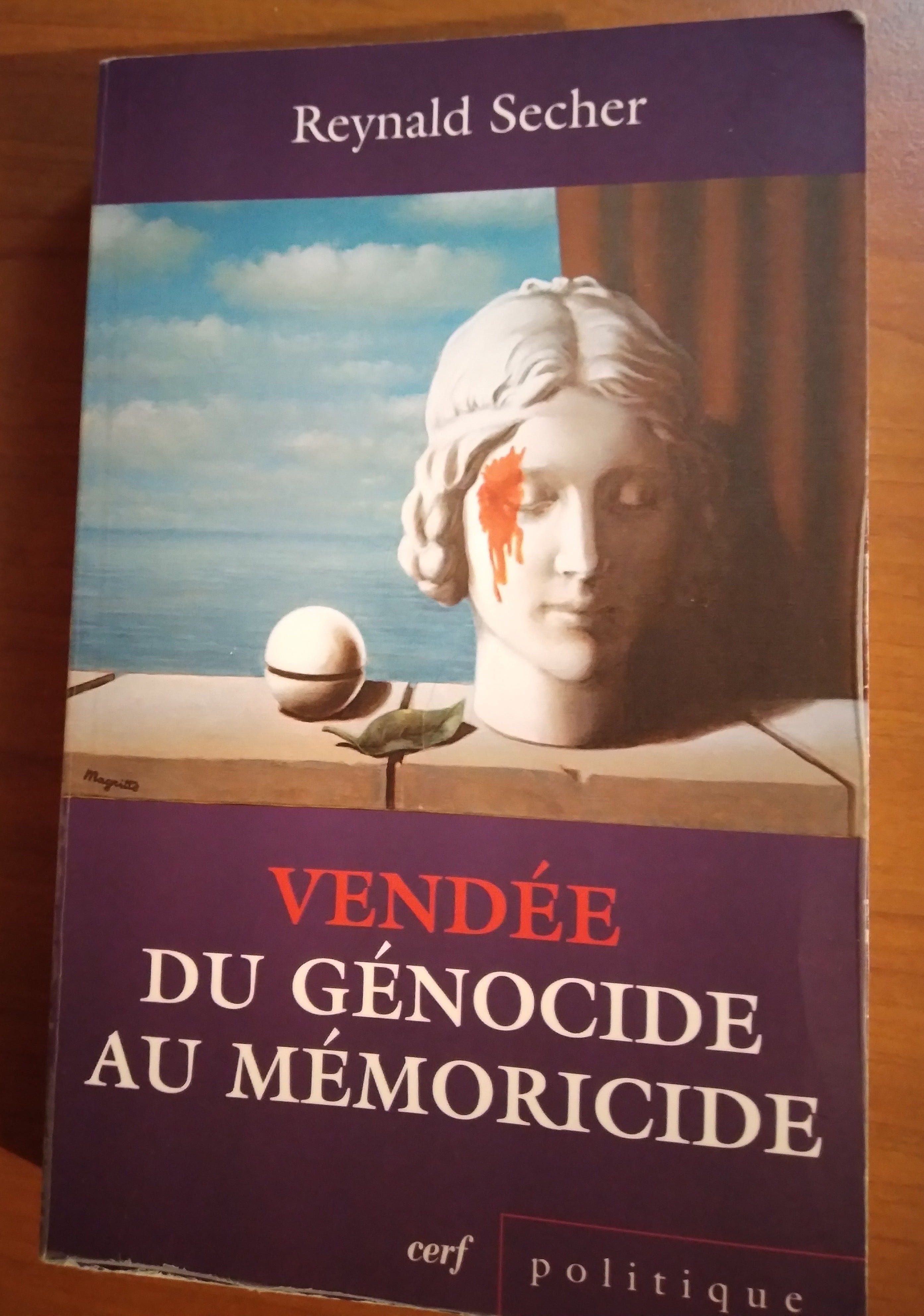
So I read Secher’s three main books on the subject4 – one with the intriguing title Juifs et Vendéens: d’un génocide à l’autre [Jews and Vendéans: from one genocide to another] – alongside a range of his critics, and analysed the discourse in the light of current debates. The process allows us to recalibrate our senses – so disordered by the onslaught of propaganda since the war in Gaza began – and to gauge what is generally thought to be plausible when it comes to genocide accusations, and what absurd.
In March 1793, a revolt broke out in the west of France. The immediate trigger was the National Convention’s conscription of 300,000 men into the French Revolutionary Army, but the malaise ran deeper. While initially supportive of the Revolution, many people in the insurgent area – which quickly became known as the Vendée – had become disillusioned. The lands of the Catholic Church had already been confiscated and monastic vows prohibited, when the Civil Constitution of the Clergy was passed in July 1790. This law required priests to swear an oath to the new Republican constitution.
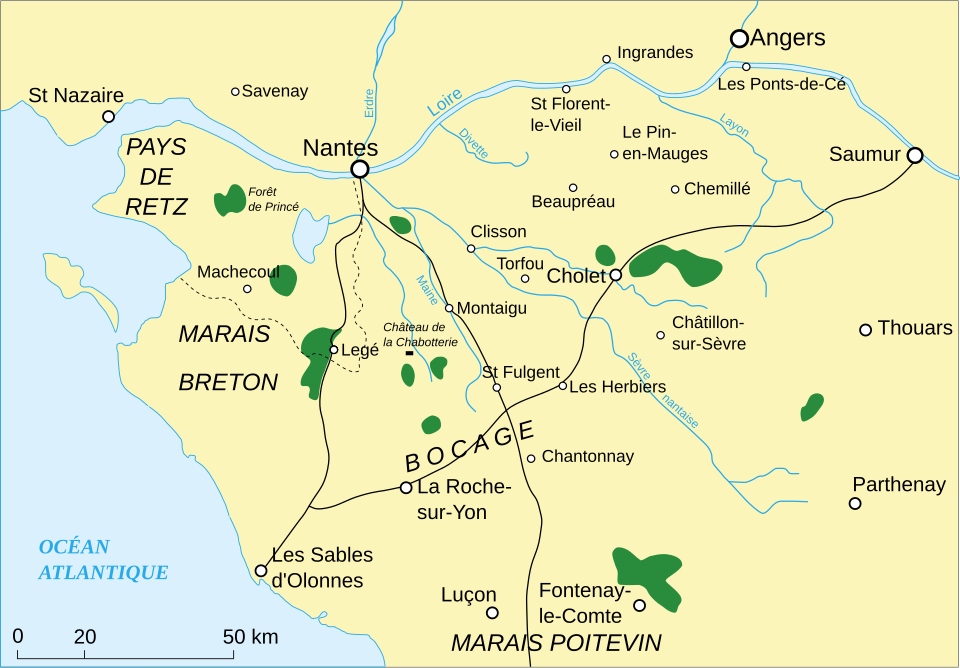
Many priests throughout France refused to take the oath, believing that it asked them to put loyalty to the state before loyalty to God. These nonjuring clergy were driven underground, while the juring clergy brought in to replace them were often hostilely treated by their parishioners.
There were also tensions between peasants and the bourgeois of the larger towns, with the latter dominating the new administrative structures and benefiting most from the forced sale of church lands. This reorganisation of power had moved centres of decision-making away from the village and the parish. Increased taxation was another cause of discontent.
Broadly speaking, the rebellion united the interests of peasants and the nobility. Its identity and aims are well expressed in the name of its military: the Catholic and Royal Army. Simon Schama gives a flavour of the religious mood:
The Vendéans often sang hymns and canticles on the march, bore standards with the Virgin Mary at the head of their regiments and wore as their device the devotional emblem of the Sacred Heart surmounted by the cross.5
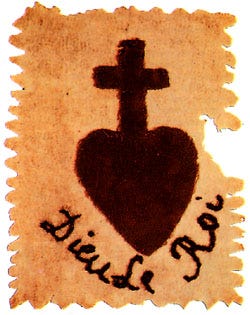
The religious suppression by the revolutionary government had inadvertently led to a resurgence in folk and mystical practices in the region, as Jean-Clément Martin describes:
The long clerical discipline imposed on the populations since the end of the seventeenth century is undermined in the name of the true religion! The popular religion that organises the community of believers asserts itself against the politico-religious encroachments of the Revolution and rediscovers to express itself the most ancient and most vital forms – that is, pilgrimages, devotions to the saints and the Virgin, and Masses celebrated outside in nature. A “contraband religion” (Michel Lagrée) thus develops in opposition to the religion imposed by the revolutionary elites, marked by the ideology of the Enlightenment.6
Irish readers cannot but catch echoes of the penal times in the clandestine lives of the nonjuring clergy. Here is a description left by the Abbé Peigné, a nineteenth-century priest and local historian, as quoted by Reynald Secher:
In the countryside, they seek refuge in the depths of the forest, in a wheat field, a deep ravine, a ditch filled with water, a humble charcoal burner’s hut or a simple cottage. Often they even hide in gloomy caves or go down into quarries and abandoned mines.
Here, surrounded by little children, they speak the Word of Life, teach the little ones to love God, to console their mothers, to pray for and forgive France. There, in a forest clearing beside the Divatte, in a secluded valley, they generally celebrate Mass an hour or two before the dawn. A table or some other piece of furniture covered in a white cloth serves as an altar, with the minimum of liturgical accoutrements (…) Often an alert interrupts the ceremony, and the priest dashes back to his hiding place. When they have hope of escaping the attentions of the Republicans, the faithful reunite in a more fitting place: a house where they choose the best room. Then the windows are carefully covered over, and they speak in low voices.”7
The rebels had a surprising run of successes in the early months of the revolt. This caused the revolutionary government a serious headache at a time when it was fighting wars abroad and suppressing revolts elsewhere in France. There were atrocities on both sides, most famously a mass slaughter committed by the insurgents at Machecoul.8
Reinforcements were sent to the region, and the Republicans won a major victory at Cholet in October. Mortally wounded in this battle, and lying on his deathbed, General Charles de Bonchamps ordered his troops to spare the lives of around 5,000 Republican prisoners. This unreciprocated act of clemency would become one of the most famous incidents of the war.
The main body of the rebel army crossed the Loire and went on a long march through Brittany and Normandy9, followed by a large train of women, children and the elderly and infirm. Eventually forced to retreat back to the Loire, the insurgents were routed at Le Mans and Savenay, followed by the massive slaughter of surviving combatants and civilians.
Most of the prisoners who were taken were kept at Nantes, where mass executions took on ghastly, sadistic dimensions. Then, in January 1794, with the rebel army more or less crushed, twelve “infernal columns” led by General Turreau, the newly appointed commander-in-chief of the Armies of the West, set out to pacify the Vendée. The troops burned homes, confiscated goods and executed men, women and children, and often rebels and patriots alike.
The Republican repression exhibited boundless contempt for human life and dignity. As Simon Schama outlines:
Every atrocity the time could imagine was meted out to the defenseless population. Women were routinely raped, children killed, both mutilated. To save powder General Cordellier ordered his men to do their work with the saber rather than the gun. At Gonnord on January 23, General Crouzat’s column forced two hundred old people, along with mothers and children, to kneel in front of a large pit they had dug; they were then shot so as to tumble into their own grave. Some who attempted to flee were struck down by the hammer of a local Patriot mason. Thirty children and two women were buried alive when earth was shoveled onto the pit.10
The pacification campaign lasted a few months, and Turreau was deposed on 13 May. The Vendée was a devastated, depopulated ruin. In a spiteful pun, the Republican government renamed the region Vendée-Vengé – or ‘Vendée Avenged’.
Guerrilla warfare11 of varying intensity rumbled on until the Napoleonic Concordat of 1801, which guaranteed unrestricted freedom of religion – a belated victory of sorts for the battered Vendéans.
As Reynald Secher argues persuasively, the repression was not just a scorched-earth policy, or standard military pacification for the times, or the excesses of poorly disciplined recruits, but the result of a deliberate policy of extermination.
An initial law of 19 March 1793 had placed the rebels outside the law and stipulated the execution of anyone supporting counterrevolutionary activity. A law of 1 August 1793 decreed that combustible materials be sent to the region to burn woods, thickets and broom. Forests were to be cut down, rebel strongholds destroyed, and rebel property appropriated. On the same day, Bertrand Barère delivered his famous “Destroy the Vendée…” report (and speech) to the National Convention on behalf of the Committee of Public Safety. This was followed by the decree of 1 October 1793, which called for extermination of the ‘brigands’. A proclamation issued by the National Convention on the same day declared:
Soldiers of Liberty, all the brigands of the Vendée must be exterminated before the end of the month of October. The salvation of the nation demands it, the impatience of the French people commands it, its courage shall accomplish it …”12
How was this decree understood by those responsible for implementing it? The instructions General Turreau sent to his lieutenants on 17 January 1794 gave a broad interpretation to the term ‘brigands’:
All brigands caught bearing arms, or found guilty of having taken up arms against their country, will be bayoneted. The same will apply to girls, women and children who have done likewise. Nor will those who are merely under suspicion be spared, although no execution may be carried out except by previous order of the general.
All villages, farm buildings, woods, heath and broom – basically anything that burns – will be set on fire, although not before any perishable supplies have been removed. But, it must be repeated, these executions must not take place until so ordered by the general.13
We will discuss Turreau’s communications in more detail later. For now, here is General Louis Grignon, who headed the first of Turreau’s columns, addressing his troops:
Comrades, we’re entering rebel country. I order you to set fire to everything that burns and to bayonet all the inhabitants you encounter on your way. I know there might be some patriots in this country; it doesn’t matter, we’ve got to sacrifice everything.14
A Republican soldier, meanwhile, wrote the following to his mother on 1 July 1794:
Circumstances haven’t permitted me to write sooner because we’re on campaign every day pursuing the brigands of the Vendée … On the 18th of last month [6 June], the brigands attacked Challans in a fierce assault … but their efforts were in vain; they lost the battle; we killed about 500 men and captured three white flags [white being the colour of the royalist army] … Since then, we’ve marched in column without being able to find any brigands except for 100 or 150 men, women and children whom we shot after capturing them scattered here and there in the countryside.15
This casual admission, in an otherwise tender letter (“I felt all the joy that true filial fondness can impart to learn that you were in good health”), is incomprehensible until we appreciate the extent to which Republican propaganda had dehumanised Vendéans.16
We could run up and down the chain of command many times over before we exhaust such examples. Secher draws the following conclusion:
[O]n 22 January [1794], in order to stay abreast of happenings, the Committee [of Public Safety], acting through Carnot, Saint-Just and Prieur, resolved that the commanding generals should write to it every day by regular post and give a brief account of their situation.
And so we have, at the highest levels of executive and legislative power, the pronouncement of a programme of extermination of a given population.
There was a vote.
There were written orders transmitted to the executing army.
There was, in compliance with orders, written communication of the facts.
These accounts were published in the newspapers and even in Le Moniteur, the official journal of the era. They were read out at the National Convention, the legislative body, and at the Committee of Public Safety, the executive body. The responsible parties and public opinion are therefore informed about the Vendéan drama.Aside from the contents of the laws, decrees, orders, the words used are no longer the same: the word ‘war’ has been replaced by ‘extermination’; the words liberty, equality and fraternity have been replaced by punishment and vengeance.17
The results were devastating. Secher estimated a minimum of 117,000 Vendéan deaths over the course of the war, corresponding to almost 15% of the population.18 The death toll is now generally thought to be higher. In La Guerre de Vendée, Jean-Clément Martin – one of the most prominent critics of Secher’s genocide thesis – adopts the calculations of Jacques Hussenet putting the Vendéan death toll at 170,00019, or around 20-25% of the population.20
In the first flush of shock at the genocide accusation, some French historians of the Vendée accused Secher of anachronism. But as Secher points out, international law already recognises the principle of retroactivity in relation to the Armenian genocides.21 In 2001, moreover, France would officially recognise the Armenian genocide of 1915.
It makes little sense to have terminology that strictly ceases to apply before the date it was created – not when prior events match the description. We know that different standards of warfare applied in the past, and that a whole body of international law governing warfare has since grown up. It does not prevent us from understanding a conflict within its proper historical context to describe it as meeting the criteria of a latterly defined crime. This is especially so in the case of the Vendée, which was understood in its own time to be a horror exceeding existing norms.22 Indeed, a contemporary journalist Gracchus Babeuf coined the term ‘populicide’ to characterise the slaughter in the Vendée. If we were to adopt a rigidly pedantic approach, we could thus describe the Vendée as a ‘populicide’ but not its modern equivalent.
In a dismissive review for Le Monde of Reynald Secher’s 2011 book Vendée: Du génocide au mémoricide, Antoine de Baecque, film critic and PhD in history, asserted that the genocide thesis had been “swiftly refuted by the historical community” and that the fuss cost Secher an academic career. He also praised the “strategy of avoidance” of Jean-Clément Martin in omitting any reference to Secher in his Dictionary of the Counterrevolution: “The absence is revealing: this way of seeking to delegitimise Secher as a historian by means of silence is certainly risky …” Thus are modern consensuses built, even if people are not usually quite so open about the process.
When an English translation of La Vendée-Vengé eventually appeared in 200323, Peter McPhee from the University of Melbourne took Secher to task for being “content to reproduce the most lurid stories as fact”24 – and with some justification. For example, the skinning of Vendéan corpses to send for tanning is well attested (even if formerly denied).25 However, this is not enough for Secher, who uncritically cites an apocryphal account of Saint-Just comparing the skin to chamois leather.26
Moreover, Secher rarely discusses the value of the sources he quotes. In Vendée: Du génocide au mémoricide, for instance, he relays the story of an executioner who had to take a break from guillotining because his arm got tired.27 The source is nineteenth-century journalist and historian Louis-Marie Prudhomme. Secher provides no indication of Prudhomme’s reliability, although the novelistic patness of the anecdote may well raise our suspicions.
Against this we must set a Republican tradition of dismissing atrocities as legendary. There were the ‘Republican marriages’ in Nantes, for example, where a man and woman, or young lad and lass, were stripped naked and tied together before being drowned in the Loire. Secher provides an abundance of solid evidence for the existence of this terrible crime.28
In his postface to Vendée: Du génocide au mémoricide, which analyses French historiography of the Vendée, Stéphane Courtois quotes major nineteenth-century historian Jules Michelet on the power of the Loire on people’s imaginations:
But the Loire had a far greater effect. This great river, of placid aspect, which, after fertilising three hundred leagues of shoreline, discharges its vast cargo of fresh water into the sea, possesses the apparent innocence of nature’s great forces. That it should have been associated with the furies of man, turned into an executioner; that, in the mystery of its waves, an entire world should have been buried – the whole Vendéan shipwreck: priests, nobles, men and women, pregnant women! and children! … the imagination was seized, horrified. Far from reducing the numbers or checking whether there was any exaggeration, people tended rather to add to them. Men love to shudder. From the probable figure of two thousand, Tronjolly raised the number to ten thousand.29
The number of victims drowned at Nantes is highly uncertain, with Jean-Clément Martin tentatively estimating somewhere between 2,000 and 4,80030 – and yes, despite Michelet’s sarcasm, there were drownings of pregnant women and children. But it is the tactic Michelet adopts here that justifies Secher’s coinage of the term “memoricide”. If mainstream histories treat real atrocities as myths, or blow a mystical fog over the whole, then the original crime is compounded by an ideological cover-up. Secher’s exposition of this process makes Vendée: Du génocide au mémoricide a valuable work despite its flaws.31
A substantial objection to the genocide claim concerns the nature of the region itself. Before the French Revolution, the Vendée was the name of an insignificant river. When the revolutionary government restructured the administration of France, it gave the name Vendée to one of the newly created departments. It was in this department and parts of three neighbouring ones that the rebellion broke out in 1793. Quickly, the Republican government began referring to the entire insurgent area as the Vendée.
Moreover, the military Vendée32 spanned parts of the three historical provinces of Poitou, Anjou and Brittany. It is not especially intuitive, then, to view the inhabitants of this inchoate region as a people.
In a critique of the genocide case from 1985, French historian François Lebrun wrote:
When it comes to a qualitative assessment, it makes sense to begin with the definition of the word genocide as given by the Robert dictionary: “methodical destruction of an ethnic group”. The question is therefore to know if the events that played out in the Vendée in 1793 and 1794 justify the use of such a term.33
In 1987, Irish historian Hugh Gough wrote a review of the literature for The Historical Journal. Entitled Genocide and the Bicentenary: The French Revolution and the Revenge of the Vendée, it maintains similarly:
Even to use the term genocide is to abuse language, for genocide involves the systematic extermination of an ethnic group, which the Jews are and the Vendéans plainly were not.34
From the perspective of today, it is odd to see historians of the 1980s so clearly unaware of the definition of group – “national, ethnic, racial or religious” – in the UN’s Genocide Convention of 1948. Then again, I suppose, the intervening years have brought Srebrenica and Rwanda and all the subsequent legal discussion, sharpening our awareness of the definitions.
Equally, some of the confusion no doubt arises from subtleties in how Reynald Secher construes the Vendéans as a group.35 In La Vendée-Vengé, he lays out his case for genocide with little reference to its legal definitions. The closest he comes to specifying his understanding of ‘group’ comes near the end of the book:
These reprisals do not therefore correspond to the awful but inevitable acts that occur amid the ferocity of battles fought out in a long and terrible war but to premeditated massacres that were organised, planned, and committed in cold blood, massive and systematic, with the deliberate and declared intention to destroy a well-defined region and exterminate a whole people, and foremost women and children, in order to wipe out a “cursed race” deemed ideologically irredeemable.36
In his 1991 book, Juifs et Vendéens: d’un genocide à l’autre, Secher claims that the Vendée meets the relevant criterion for genocide because the Vendéans were a “religious group, as they were exterminated on account of their religious beliefs”37.
As we discussed above, the area of the Vendée had a distinctive religious culture – one that presented, by its ancient and deeply rooted nature, an obstacle to the creation of the homme nouveau of the Revolution. In a Manichaean worldview38 where all elements of life that are at odds with the Revolution are cast as counterrevolutionary, traditional religious faith posed an existential threat.
Moreover, these Vendéans were backwards – benighted, superstitious, clergy-ridden peasantry in thrall to the aristocracy. There was no reasoning with such people, who simply would not recognise the benefits of liberty the Revolution had brought.
There is a strong argument here, especially given the religious repression that inspired the war. But in Vendée: Du génocide au mémoricide, Secher reverts to more general formulations such as “defined population”.39 At one point, he writes:
In effect, unlike the Jews or the Armenians, [the Vendéans] constitute neither a people nor an ethnicity but a group of humans inhabiting the same territory, the military Vendée, whose seeds of identity took shape during the events linked to the civil war and the genocide.40
If Secher is guilty of some prevarication, or at least hedging, on this point, it is also worth remembering that genocide jurisprudence takes into account the perspective of the perpetrator in determining a targeted group. With this in mind, consider the following dispatch by the Committee of Public Safety to representative-on-mission Jean Dembarrère:
Kill the brigands instead of burning the farms, punish deserters and cowards and utterly crush this horrible Vendée … Work with General Turreau to bring together the surest means to completely exterminate this race of brigands.41
General Beaufort wrote of the need to “fully purge the soil of liberty of this cursed race”.42 And General Cordellier referred to an “impure race” to be exterminated.43
Secher provides the following etymological context: “In the eighteenth century, the word ‘race’ has a specific meaning: it denotes all of the male and female ascendants and descendants of a family, a people.”44 However, he fails to fully contextualise the term as it was used during the Revolutionary period. For example, Robespierre used the exact phrase “impure race” to refer to all the internal enemies of the Republic, and not specifically the Vendéans.45 This shared lexical usage is similar to that of ‘brigands’, which was applied to all kinds of enemies of the Revolution. You will not find any general discussion of these terminological questions in Secher, or at least any that complicates his thesis.
For all that, there is a genuine sense in which the Vendéans were actually viewed in racialised terms. To understand this, we must recall a time when isolated country folk, with their primitive beliefs and rustic features, could be seen almost as a separate race. A remarkable glimpse of this mode of thinking is afforded by the attitudes of Jules Michelet46. Here he describes his reaction to seeing a plaster death mask of Vendéan general François de Charette:
I was dumbfounded. One truly senses a race apart, most fortunately extinct, like several savage races. Viewed from behind, the bony box of the skull is like that of a powerful cat. There is a furious bestiality there, which is feline in nature. The brow is broad and low. The mask has a powerful, martial, villainous ugliness, apt to trouble all women …47
Given that Charette was an aristocrat, I probably do not need to add that Michelet’s views of the average Vendéan peasant are even cruder.
Starting with François Lebrun, many critics of the genocide thesis have made the historical argument that the grim atrocities of the Vendée were more akin to the horrors of military campaigns from the relatively recent past than to the totalitarian excesses of the twentieth century. Lebrun cites repression of the Nu-Pieds revolt in Normandy (1639) and the Bonnets Rouges revolt in Brittany (1675):
[We see] the same incomprehension, a century and a half apart, on the part of the authorities with regard to the insurgent populations in whom they see only rebellious subjects, backwards and stupid peasants incapable of understanding the public good. As Cardinal Richelieu writes in his political testament: “When it comes to crimes of state, we must close the door to pity, disregard the complaints of interested parties and the discourse of an ignorant populace that sometimes criticises what is most useful and often entirely necessary.” During the Breton revolts of 1675, the bishop of Saint-Malo writes to Colbert: “If, among this crude and brutal people, there was anyone capable of understanding reason, there would be cause for hope […], but as they do not understand even the French tongue, I believe that only punishment of their crimes will be capable of preventing them from committing new ones in the future.”48
The callousness of these statements should not distract us from noticing that they come nowhere near the exterminatory rhetoric of leading Republican politicians and generals concerning the Vendée.
Lebrun also quotes a letter by Louis XIII dispatching the colonel Jean de Gassion to crush the Norman rebels:
I would like you to proceed with the greatest possible haste with all my troops to Avranches, so that you can cut the seditionists to pieces wherever they may be assembled, and raze the suburbs of the town of Avranches.49
But of course if the Republican government had limited its laws, decrees and orders to the slaughtering of seditionists and to razing the suburbs of this or that insurgent town, the question of genocide would not arise in the first place.
Lebrun also mentions the French destruction of the Palatinate in 1689 and the War of the Camisards (1702-1710). Jean-Clément Martin adds to the list:
The repression unleashed upon the Vendée forms part of the “terror” implemented throughout France. What happens in the Vendée is no different, in its nature, than what Saliceti carries out in Toulon, or the treatment that is applied in Lyon or Marseille, or to a lesser extent in Bordeaux, in the summer of 1794. It is also akin to the military violence that strikes Italy after 1797, or Spain in the years 1807-1812.50
Ultimately, the truth of this claim depends on how we interpret the highly elastic phrase “by its nature”.
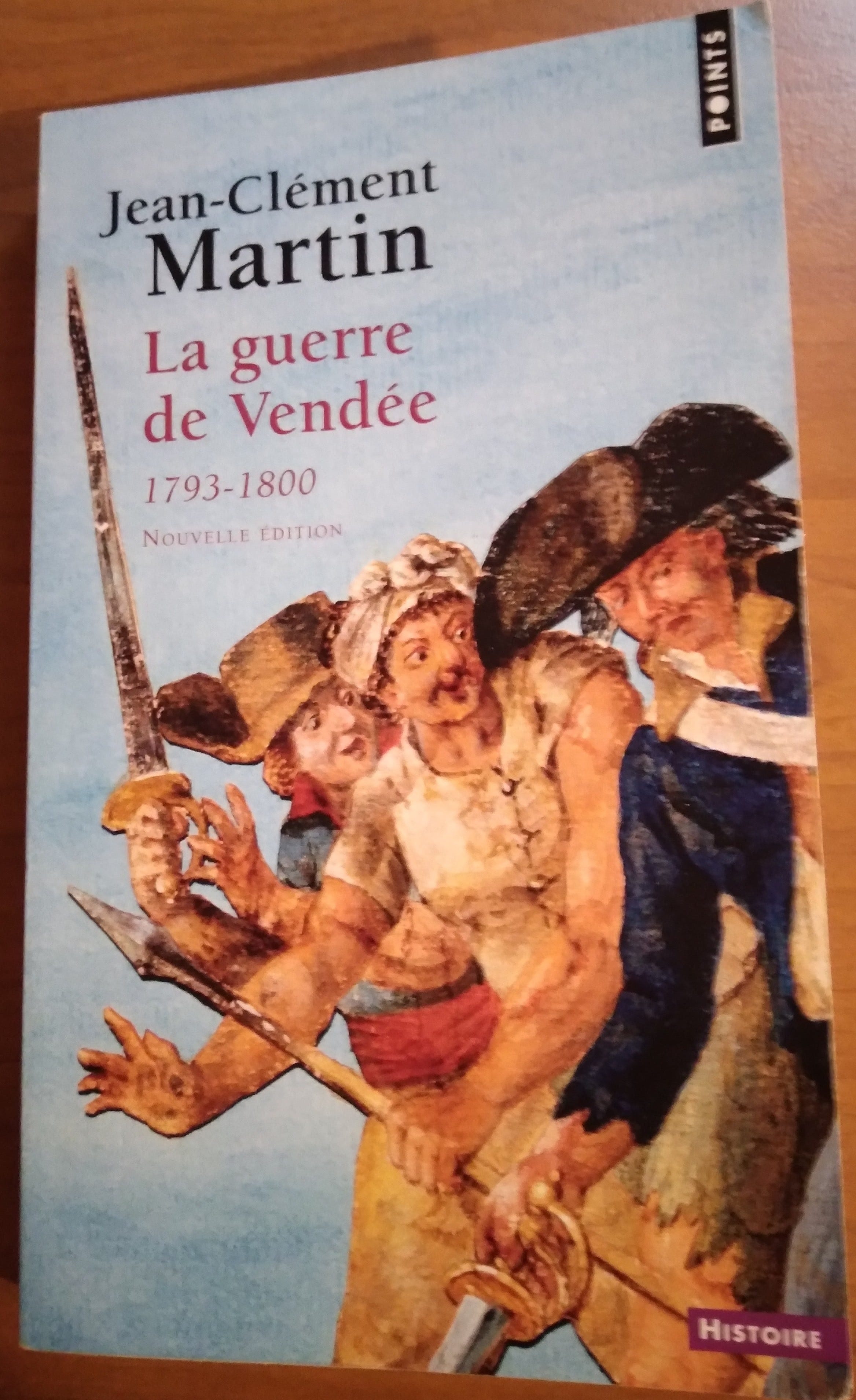
Martin is often presented, and presents himself, as a centrist voice on the genocide debate. His book La Vendée et La France was published in 1987 both as a general history of the War in the Vendée and a detailed riposte to Reynald Secher’s troubling claims. It is the updated edition of this book from 2014, retitled La guerre de Vendée, that I discuss here. The quote above is typical of his concern to channel the Vendée into the main course of history, even though he is often too scrupulous to succeed.
For example, he writes:
From the month of April, the troops of Beysser terrorise the region around Nantes. They do not take prisoners, and they pillage and burn as they advance. The practice is approved by the general himself, who declares that “we should not see the human in the bad citizen, but the enemy of the human species.”51
Although this is more or less classic scorched-earth practice, the rhetoric adds a new and disturbing element that at least partially explains why the atrocities in the Vendée took on such dimensions. It also smacks much more of Stalin and Pol Pot than it does of Louis XIII or Cardinal Richelieu.
Again with admirable frankness, Martin states: “The Vendée region is confirmed [in its identity] by the perverse effects of the political anathema flung at the revolt since March. Land of betrayal, it will suffer an unjustified and unjustifiable military repression which will intensify the war to the worst extremities.”52 Later he refers to an “exceptional policy of repression”.53
It is not unreasonable to see these extremities, this exceptional brutality, as the consequences not just of an embattled government, riven by deadly rivalries, perpetuating, to an extreme extent, the violent practices of the ancien régime, as Martin argues, but as following from an extreme ideology that brought forth the same horrors in the twentieth century. As Robespierre famously put it: “The revolutionary government owes to the good citizen all the protection of the nation; it owes nothing to the enemies of the people but death.”54
Note the following statement by representative-on-mission Jean-Baptiste Carrier, who was responsible for such horrors and cruelty in Nantes:
We will make a cemetery of France rather than fail to regenerate it in our fashion and miss the target we have set ourselves.55
Is this not an expression of a worldview alien to the seventeenth century and stamped with the dark face of the Enlightenment?
Nor is this sense of a monstrous new crime in the Vendée an ex post facto interpretation. During the trial of the Nantes Revolutionary Committee in 1795, for instance, lawyer Guillaume-Alexandre Tronson-Ducoudray decried “a new frenzy that surpasses the ordinary forces of crime”.56 And then there were the Republican generals who were disgusted by the war in the Vendée and wanted nothing to do with it, even at the risk of their careers. General Dumas, father of the novelist Alexandre, is a prominent example.
Furthermore, the Republicans concocted plans for using gas, poison and mines in the service of mass-killing. They even tested an invention by a chemist called Proust, whereby a ball filled with germ agent was to poison the air over a wide area.57 Although none of these ideas went very far, they foreshadow. In Simon Schama’s pithy summation: “The mass production of death through the marriage of technology and bureaucracy would have to wait another century and a half.”58
The atrocities of this period of history were captured by Francisco Goya in The Disasters of War59. This haunting series of prints depict the brutal nightmare of the Peninsular War, for which the Vendée was a model in some respects. But it is Goya’s enigmatic earlier print The Sleep of Reason Produces Monsters that can shed some light on the question we are discussing. It shows an artist asleep at his desk, surrounded by nocturnal creatures, mostly owls and bats. It can be read as a manifesto of Enlightenment ideals, a call to vigilance against superstition. But the Spanish title is in fact perfectly ambiguous and could equally read, The Dream of Reason Produces Monsters.
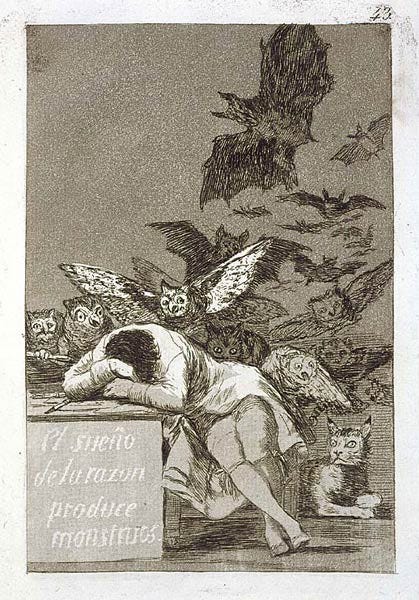
Arguably it was the dream of reason – always so threatened, always so close – that produced the horrors of the Vendée. Aleksandr Solzhenitsyn certainly thought so. In a speech given in 1993 at the inauguration of a Vendée memorial at Lucs-sur-Boulogne (site of horrendous massacres, including of large numbers of women and children60), the great dissident and writer brought his habitual acuity to the matter:
Twenty decades have now passed, and throughout that period the Vendée uprising and its bloody suppression have been viewed in ever new ways, in France and elsewhere. Indeed, historical events are never fully understood in the heat of their own time, but only at a great distance, after a cooling of passions. For all too long, we did not want to hear or admit what cried out with the voices of those who perished, or were burned alive: that the peasants of a hard-working region, driven to the extremes of oppression and humiliation by a revolution supposedly carried out for their sake – that these peasants had risen up against the revolution!
That revolution brings out instincts of primordial barbarism, the sinister forces of envy, greed, and hatred – this even its contemporaries could see all too well. They paid a terrible enough price for the mass psychosis of the day, when merely moderate behavior, or even the perception of such, already appeared to be a crime. But the twentieth century has done especially much to tarnish the romantic luster of revolution which still prevailed in the eighteenth century. As half-centuries and centuries have passed, people have learned from their own misfortunes that revolutions demolish the organic structures of society, disrupt the natural flow of life, destroy the best elements of the population and give free rein to the worst; that a revolution never brings prosperity to a nation, but benefits only a few shameless opportunists, while to the country as a whole it heralds countless deaths, widespread impoverishment, and, in the gravest cases, a long-lasting degeneration of the people.61
So I cannot subscribe to Martin’s view that “the climate of the era is less the result of revolutionary ideology than its horizon”62. Nevertheless, he makes some robust arguments against the genocide case, such as: The same language of extermination used against the Vendéans was also used elsewhere; the laws and decrees targeted ‘brigands’ as they targeted ‘brigands’ everywhere; the administration officially recognised refugees from the Vendée and took measures to help the widows and children of patriots – in this way and others, rebels and patriots were treated differently; the laws excluded, or could be supposed to exclude, women and children and non-brigands more generally.
All of these points tell part of the story. While true that the language of brigands and extermination was widespread throughout the Terror, it took on a special vehemence and generalised character in relation to the Vendée. Measures to protect and help patriots and their families do indeed point to the targeting of a political enemy rather than the killing of an undifferentiated group. But this must be set alongside the frequent indiscriminate massacres of rebels and patriots alike, and the statements of leaders like General Grignon quoted above (“I know there might be some patriots in this country; it doesn’t matter, we’ve got to sacrifice everything.”).
As for the treatment of women and children, this is where things get complicated – not to mention distressing. Brigade General Danican63 would write in October 1794: “The atrocities that were committed before my eyes have really affected my heart such that I will never regret dying.”64
Secher quotes Baron Dupin, who carried out population and statistical studies in the region in 1800-01:
In the districts of Thouars and Parthenay, the population of the female sex exceeds that of the male sex, by about a fourteenth in the former and about a twelfth in the latter. It is astonishing that this proportion is not greater. Before 1790, it was the ambition of many countryfolk to place their sons in monasteries or at least in the priesthood: it is therefore probable that in this period, there was a slightly larger number of women than men; and as men are ordinarily more exposed to the hazards of war than women, we would expect the number of women today to greatly exceed that of men in the first district65 after a war that swallowed up more than a third of its population. We have good reason therefore to be surprised when we see that the two sexes are found there in almost equal numbers, and consequently that roughly the same number of women perished as men. This circumstance alone suffices to characterise the war in the Vendée.66
How could this be if, as Martin claims (in a crucial part of his argument, which we will be analysing in detail):
Let us simply recall that there was no law or decree aimed at a group called “the Vendéans”, but that all the orders of extermination were issued against “the brigands of the Vendée”, while it was deemed appropriate that non-brigands (women, children, the elderly and even unarmed men) be protected.67
Did the military just ignore their civilian leaders? And why does Martin’s prose become unusually strained (“…while it was deemed appropriate that …”)?
First of all, Martin’s framing excludes all the rhetoric in the highest offices that cast the repression in generalised terms, such as Danton’s call to “exterminate the Vendée”68!
Secondly, consider the following correspondence in which General Turreau sought cover for his plan for the Vendée. On 24 December 1793, he wrote to the Committee of Public Safety as follows:
I request express authorisation or a decree or order to burn all the towns, villages and hamlets of the Vendée that do not support the Revolution and which constantly supply new support for fanaticism and the monarchy.69
Not receiving a reply, he wrote to the representatives-on-mission70 on 17 January 1794:
My intention is indeed to burn everything, to preserve only the places necessary for establishing the billeting quarters from which to destroy the rebels, but this large-scale measure must be prescribed by you. I am merely the passive instrument of the legislative body’s wishes, which you represent here. You must also state your position in advance on the fate of the women and children I will encounter in this rebel country. If we are supposed to put them all to the sword, I cannot execute such a measure without an order that covers my responsibility.71
Anxious about the lack of reply, he wrote to the Committee of Public Safety on around the same date:
The military promenade I am contemplating will be finished on 4 or 5 February. I repeat, I consider it necessary to burn towns, villages and farms, without which I will not be able to vouch for the annihilation of this horde of brigands who seem to find new resources every day.
He is made to wait, but then, on 8 February he gets the approval he has been soliciting in the form of a letter from the Committee of Public Safety:
You complain, citizen general, of not having received formal approval of your measures. They seem good and pure to the Committee but, far removed from the theatre of operations, it awaits great results before pronouncing on a matter in which it has so often been deceived in the past. Exterminate the brigands down to the last one; that is your duty.72
It is reasonable to conclude, from this and similar correspondence, that the Committee of Public Safety approved Turreau’s intention to bayonet women and children, irrespective of any legal provisions to protect them. This undermines Martin’s argument and possibly accounts for his brief and incomplete treatment of this episode73, as if the full implications were too painful to contemplate.
The priorities of the Committee of Public Safety are captured by a letter sent to representative-on-mission Jacques Léonard Laplanche in November 1793:
In the midst of these great interests, forget the specific accusations motivated by the energetic measures you have taken. Respond to talk with action. Be assured that if these accusations were to reach the Convention, every patriot would stand up to defend you. The Committee thanks you for the details you are providing on the progress of the rebels.74
Moreover, when Turreau was put on trial in 1795 for his actions in the Vendée, he was acquitted because he had only obeyed orders from higher authorities – that is, the representatives-on-mission and the Committee of Public Safety – while also benefiting from an amnesty.
But that is not all. Did official laws/policy in fact provide for the safety of women and children, as Martin maintains? (Or to return to his tortured formulation, was it deemed appropriate that they be protected?)
Article VIII of the law of 1 August 1793 had stipulated that women, children and the elderly were to be conducted into the interior, with provision for their subsistence and safety with all due regard to their humanity. But the decree of 1 October – the so-called “law of extermination” – provided no such safeguards. So, how was it to be interpreted?
For Secher, this “complementary amending law calls into question Article 8 of the law of 1 August”75. For Martin, it was appropriate for the Republican military to assume that Article 8 still held, even if it frequently acted as if it did not. On this crucial point in the debate, it is not clear to me who is right. It is a testament to the polemical nature of the issue, however, that this crucial question has to be teased out of tricky phrasing (Martin) and bald assertion (Secher) by means of comparative analysis.
So, did the 1 October law represent a whole new approach that overrode the safeguards of the law of 1 August? How are we to weigh the differential treatment of Vendéan patriots and rebels in some cases76, and their indifferent slaughter in others? How do we square the killing of women and children in huge numbers with the ambiguous, contradictory and evolving laws, orders and rhetoric of the Republican administration? How significant is it that some of Turreau’s infernal columns were far less brutal than others? Can we range the Vendée in the crowded landscape of historical atrocities, or was it something rare and terrible? And can the Vendéans be considered a protected group under existing genocide jurisprudence?
These are not easy questions to answer, and they explain why outside of France, where the polemic is less sharp, some historians settle for phrases like “near-genocide”77 and “almost genocidal mass killings”78.
At any rate, according to mainstream French historical opinion, the Vendée is definitely not a genocide – and it is scandalous to say so. And according to mainstream historical opinion outside of France, the Vendée is not quite a genocide.
As mentioned above, the Vendéan death toll is estimated at 170,000, or around 20-25% of the population. In terms of proportion, this actually puts the Vendée at the low end when it comes to genocides. Whenever genocide has been legally found to pertain, the proportion of population killed has been in the 20-80% range79.
In Gaza, by contrast, some 3% of the population has died in the war.
That is to say, the Vendée meets the substantiality requirement in genocide case law, whereby a substantial part of the protected group must be targeted, and Gaza falls short by a long way.
The laws and directives of the Republican government give strong grounds for arguing that the widely indiscriminate slaughter was consciously planned and ordered from on high, and that it targeted a region and its people as such. By contrast, there are no such laws or directives by the Israeli government. And the rhetoric of Israeli political and military leaders, even in the immediate aftermath of 7 October, is watery compared to the exterminatory invective of leading revolutionary figures.
In the Vendée, there is irrefutable evidence that much of the killing served no military purpose. In the Vendée, it is reasonable to infer – even if not perhaps the only possible inference – that the vast war crimes committed by the troops followed from the directives of the government, were the implementation of its will. And beyond that, there is a case that the actions of Turreau’s columns, in large part, can only point to genocidal intent.
Yet mainstream historical opinion holds that there was no genocide.
In Gaza, none of these things pertain – not nearly, not at all80 – and yet we are expected to believe that a genocide has occurred.
Here is distinguished historian François Lebrun from the same piece I quoted above:
Overall, nothing in the manner in which the war in the Vendée is conducted between March and December 1793 justifies the use of the term genocide. The dead in the spring and the summer are men killed in combat. As for the 70,000 disappeared of the Virée de Galerne81, among which there are numerous women and children, these are the sad victims of a terrible civil war.82
I would remind readers that 70,000 is almost the entire number of fatalities in Gaza over the course of the war. And that the Virée de Galerne is before we even get to the executions and drownings at Nantes and elsewhere, and before Turreau and his infernal columns. Moreover, for Lebrun, the idea of a genocide in the Vendée is not only false, but absurd.
Furthermore, the Vendée suffered from depopulation for many years after the war. Apart from the 170,000 or so dead, there were few births. As Reynald Secher puts it:
Between 1793 and 1795, the Vendéans were in no fit state to have lots of children, and many of those who were born perished at the hands of the infernal columns.83
Consider the following argument by Jean-Clément Martin. Recall that Martin is regarded as a solid, non-politically-aligned source on the Vendée. We could fairly say, therefore, that this reflects a more or less mainstream view on genocide when Israel is not the one accused:
Then, as cynical as it might seem, it makes sense to take a long view of the demographic toll. The population haemorrhaging that is inflicted on the West is significant, but it is not irremediable. The population does not disappear in the tumult; it is not even dispersed to the point of losing its unity, its identity or its social structures. Just the opposite, in fact, we have seen that from 1796-97, the regional society finds an equilibrium and a dynamic, both social and demographic, that assures its continuity and its future. The Vendée did not experience the fate of Armenia in 1915 or Cambodia in 1975. It was able on its own to resist the military pressure that was brought to bear on it, and it emerged strengthened from the trial. The prefect Dupin observed that the demographic losses suffered by Deux-Sèvres corresponded to the increase that the department had recorded over the entire course of the eighteenth century. The figures confirm it; the region is repopulated, in the years 1820-1830, to the exact number of inhabitants it had in 1790. Even if some villages lost half of their population in these three years of war, there was no ‘genocide’ on the regional scale.84
That is, the population being set back to the levels of around 95 years earlier, and then recovering to pre-war levels within some 25-35 years, is an argument against there being a genocide.
In Gaza, high birth rates have offset a large part of the population loss through death. And although exact figures remain uncertain and controversial, even conservative estimates of the number of births would place Gaza’s current population at the levels that existed just a few years before the start of the war, while the population will almost certainly recover to pre-war levels within a couple of years at most.
In many ways, the Vendée is what anti-Israel activists desperately want Gaza to be. In November 2024, the UN’s Human Rights Office reported that close to 70% of the victims it verified in Gaza over a six-month period were women and children.85 This statistic was proven to be wildly off the mark (or at the very least, unrepresentative to a highly dubious degree), by the Gazan Ministry of Health’s own figures released in February 2026, which showed that more men were killed than women and children combined; and that by proportion of population, men were killed at a much higher rate than women or children.86
The IDF giving advance warning of strikes, creating humanitarian corridors and providing aid and healthcare to civilians – actions contrary to any intent to wipe out the population – does not register. Instead, we get bogus stories of Israel trafficking in the skin of dead Palestinians.87
In fact, when it comes to the atrocities of the Vendée – the sadism, the sexual violence, the gratuitous and wilful murder of women, children and the elderly, house to house, place to place – and dehumanisation of the enemy, it is in fact Hamas and the Gazan administration that most resembles the Republicans at their worst. This is not to say that some Israelis, to their shame, do not dehumanise Palestinians as a group, but that the widespread hatred of a people, led from the top and thoroughly institutionalised, is much more characteristic of Gazan than Israeli society, and accounts in large measure for the depravities of 7 October.
Almost all of Reynald Secher’s critics agree on one thing: that the genocide claim is an abuse of language. Hugo Gough: “Even to use the term genocide is an abuse of language.” François Lebrun: “Speaking of genocide in these two cases [the Vendée and the War of the Camisards] would spring from the same abuse of language.” Peter McPhee: “radical misuse of [a] term” that Raphael Lemkin coined “with a view to capturing the unique horror of the Jewish experience in Hitler’s Europe”.
However much this applies to the Vendée, it applies many times over to Gaza.
Presumably stung by these accusations, Reynald Secher addresses the issue in Juifs et Vendéens. While relating the Vendée so directly to the Holocaust is fraught with risk, it is only making explicit what we mean when we use the word “genocide”, of which the Holocaust is the paradigmatic example. And for the most part, the book is well-judged and illuminating.
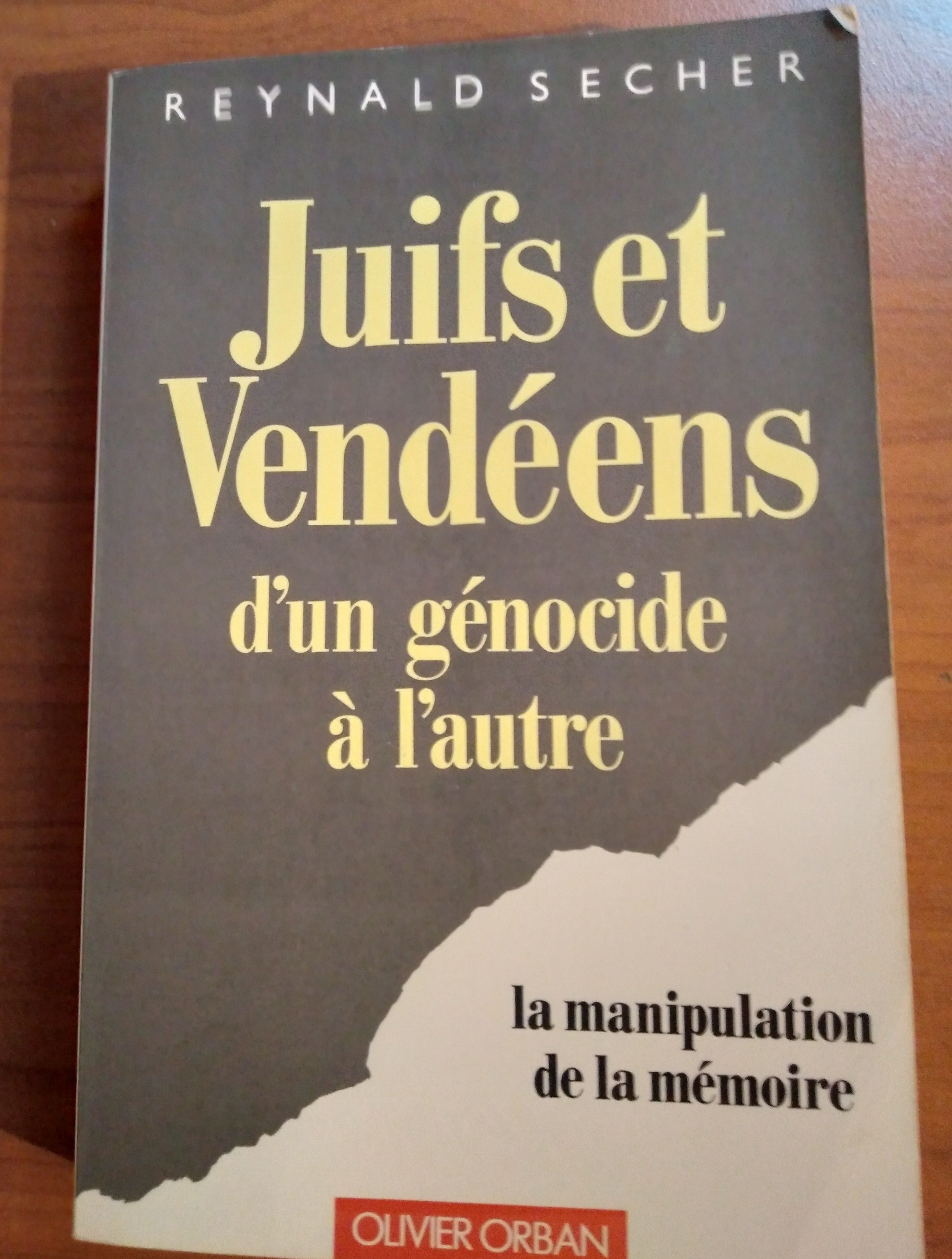
Secher argues that if the memory of the Vendée had not been suppressed, people in occupied France might not have been so slow to believe the first accounts filtering back from the concentration camps, and to understand what was going on.88
Following a description of an encounter with a Jewish woman who had lost her entire family in the death camps, he quotes her as saying: “I hope that in two or three hundred years the Jews will have a historian like you to recall their tragedy.” The woman enjoins Secher to write a work describing how the memory of the crime committed in the Vendée was strangled, and detailing the various mechanisms of suppression. This would help in the fight for historical truth, against those who would cast doubt on the Shoah – a process that was already underway. Secher continues:
Without doubt, historical objectivity is difficult to obtain, but, beyond prejudices, there are facts that are essential components for making one’s own opinion and which one should know. If not …
If not, we arrive at a stage where anything goes89, and this anything-goes leads to denial of the genocide committed in the Vendée and could soon lead to the denial of the genocide of Jews.90
Having solemnly declared that he does not intend to banalise or relativise the Holocaust91, and having berated his critics for banalising and relativising the events of the Vendée by relating them to the practices of the ancien régime92, Secher writes:
Certain people are already beginning to relativise, to banalise the [Holocaust]. To this end, they use the arguments already employed for the Vendée by claiming that there were just as many Germans killed, notably in the camps established by the Allies after the German defeat.93
This is typical of how Secher, from the perspective of the early 1990s, conceptualises Holocaust relativisation and denial – the sort of insidious falsehood, based on a battery of tricky lies and misrepresentations, practiced by David Irving. He does not foresee the Holocaust relativisation of the left, nor recognise its lineaments in the discourse of the day.
The book the Jewish woman asked Secher to write would be published twenty years later. Vendée: Du génocide au mémoricide is a substantial intellectual work that brings out the immensity of what happened in the Vendée. In doing so, it draws on the psychological work on collective trauma and memory by scholars of the Shoah and the Armenian genocide. And while ‘memoricide’ might seem like a dubious neologism, Secher does a good job of illuminating the historical processes of forgetting and suppressing.
At the end of the book, however, he declares himself in full agreement with the following statement by Franco-Algerian scholar Jamel Eddine Bencheikh:
I must reiterate: I bind to my conscience the Jews, the Palestinians, the Armenians, the Kurds and every people which has been, in recent times or long ago, victims of an attempted extermination, committed by this or that perpetrator. If I do not take crimes against humanity upon myself, I have no right to denounce any of them.94
And there we have it, the very thing Secher so strenuously denied.
There has been no attempted extermination of Arab Palestinians. This is a categorical historical fact, about which Secher claims to care. “Palestinians” simply does not belong in that list if you are a historian who cares about the truth. Not in 1991 when Bencheikh created that intellectually false, morally revolting equivalence, not when Secher published his book in 2011, and not today.
So, what is Secher’s game when it comes to the Vendée? Does he literally think there was a genocide, an actual crime with a defined meaning, or is it just a handy gambit for those with Catholic and royalist sympathies to undermine the French Republic?
If a historian solemnly claims that he would never relativise the Holocaust, and yet approvingly quotes somebody who does – note the vile contiguity of Jews and Palestinians, of the Shoah and a non-existent Jewish-committed equivalent95, in the Bencheikh quote – how are we to judge his sincerity when introducing a new genocide to the world?
And if we admit some nebulous attempted extermination of Palestinians by Jews, then anything goes, anything at all, n’importe quoi. Sure, there was a genocide in the Vendée, just like there was in the Palatinate, and of the Camisards. Indeed, the massacre committed by the Vendéans at Machecoul could also be a genocide. And then we can create equivalences between the genocide suffered by the Vendéans and the one they committed. We can piously declare that if we do not recognise them all, then we cannot recognise any of them.
In Matti Friedman’s brilliant survey of the execrable activist literature on Gaza, he writes: “[Pankaj] Mishra’s project, as far as I can tell, is to replace the genocide of Jews in the Western mind with a genocide by Jews”.96
This could be seen as the project that unites the ideological right and left, as evidenced recently by the sudden appreciation of Tucker Carlson by the likes of Mehdi Hasan the moment the former began repackaging low-rent Holocaust inversion for a new age.
One way to do this is to proliferate accusations of genocide, to create a landscape of genocides. In this cluttered topography, there is the Shoah and Armenia and the Vendée and various poorly defined genocides of Palestinians; there is Gaza specifically; and countless others, real, contested and imagined – mounds and buttes, foothills and peaks, ranges and hills, all jumbled together.
It is very easy to lose one’s bearings in such a landscape, very easy to see the Holocaust as just one genocide to be set aside the several Jewish-committed genocides against the Palestinians.
In fact, we could say that this moral confusion is the general climate in some countries. When Margaret Connolly, the sister of Irish President Catherine Connolly, returned from the latest Gaza flotilla stunt, she described a brief boat journey in which nobody was killed or seriously injured to the Holocaust. This did not prevent the Irish media from fawning over her, or cause them to question the veracity of her accounts.
To counter this moral confusion, we need to insist on the real meaning of concepts, and that they be applied equally to the Jewish state as they are to non-Jewish states. This is rendered harder by cynical actions such as the Irish government’s attempt, in its submission to the International Court of Justice in support of South Africa’s vexatious case against Israel, to broaden the definition of genocide.
Moreover, once we admit one imaginary genocide into the canon, or broaden the definition in ad hoc fashion to catch the world’s only Jewish state, then genocide denial becomes utterly destabilised. The term then includes denying things that are true and things that are false.
In Juifs et Vendéens, Reynald Secher writes:
Let us suppose that in 150 years, at the rate things are going, or perhaps before that, nobody will remember this abomination [the Shoah], that it will even be forbidden to mention it in the name of some superior interest, and that historians inquiring into this question will risk being sanctioned.97
Or let us picture a world where the Shoah cannot be commemorated without placing it alongside imaginary genocides, and in particular imaginary genocides committed by Jews, so as not to offend the sensibilities of those who would eradicate the world’s only Jewish state from the river to the sea, and would bury the truth in a field of lies.
Notes
[1] That is, the Montagnard faction.
[2] Secher’s family roots are in La Chapelle-Basse-Mer.
[3] It is maybe an interesting thought exercise to consider a priori, equipped with these two facts alone, which accusation of genocide is more likely to be true.
[4] The three Reynald Secher books are:
i) La Vendée-Vengé: Le génocide franco-français (1986), Perrin. An English translation by George Holoch was published by University of Notre Dame Press in 2003 with the title ‘A French Genocide: The Vendée’.
ii) Juifs et Vendéens: d’un génocide à l’autre (1991), Olivier Orban.
iii) Vendée: Du génocide au mémoricide (2011), Cerf Politique.
The latter two books have not been translated into English.
[5] Simon Schama, Citizens (1989), Penguin, p. 597
[6] Jean-Clément Martin, La guerre de Vendée, Points, p. 84. Translation mine.
[7] La Vendée-Vengé, p. 95. Translation mine.
[8] Having pointed to the difficulty of estimating the casualties, Jean-Clément Martin says perhaps several hundred were killed, with 160 names attested (La guerre de Vendée, p. 126). Reynald Secher argues in Juifs et Vendéens (pp. 183-84) that the execution of 300 Vendéan prisoners at Pornic provoked the majority of the killings at Machecoul, with the execution of 150-60 Republicans in retaliation. The atrocities committed there, including the horrible murder of civilians, were to form an important part of Republican propaganda.
[9] The so-called Virée de Galerne.
[10] Citizens, p. 668
[11] As an etymological tidbit, here is a passage from Citizens (p. 598): “When the French generals who had fought in the Vendée discovered, to their dismay, similar conditions in the Peninsular War in Spain fifteen years later, they referred to it as “la petite guerre,” which in Spanish became rendered as guerrilla.”
[12] Quoted in Juifs et Vendéens, p. 45. Translation mine.
[13] Quoted in La Vendée-Vengé, p. 158. Typically, Secher abbreviates the quote in a way that lends maximal force to his argument. I have provided the full, continuous excerpt here.
[14] Quoted in La Vendée-Vengé, p. 159. Translation mine.
[15] Quoted in Vendée: Du génocide au mémoricide, p. 116. Translation mine.
[16] Readers might recognise the kinship with the Hamas fighter on October 7 who rang home to tell his parents how he had killed two Jews with his own hands.
[17] Juifs et Vendéens, pp. 65-66. Translation mine.
[18] La Vendée-Vengé, p. 253.
[19] La guerre de Vendée, p. 299.
[20] The percentages are based on the respective authors’ own estimates of the population.
[21] Juifs et Vendéens, p. 84.
[22] Two of the main actors, Carrier and Turreau, faced tribunals in 1794 and 1795 respectively. During Carrier’s trial, the public prosecutor declared, in characteristically florid terms: “In the remotest regions of the world, in all the pages of history, even the barbarian centuries, we would struggle to find horrors approaching those committed by the accused …” Quoted in Juifs et Vendéens, p. 75 Translation mine.
[23] Entitled ‘A French Genocide: The Vendée’; see endnote 4.
[24] Peter McPhee, H-France Review Vol. 4 (March 2004), No. 26.
See: https://www.h-france.net/vol4reviews/mcphee3.html
[25] See e.g.: La guerre de Vendée, p. 180.
[26] La Vendée-Vengé, p. 175
[27] Vendée: Du génocide au mémoricide, p. 98
[28] Vendée: Du génocide au mémoricide, p. 249-51
[29] Vendée: Du génocide au mémoricide, p. 367. Translation mine.
[30] La guerre de Vendée, p. 219.
[31] In invoking the power of legend, Michelet has his modern successors in Catherine Philip and Gabrielle Weininger, who published an article in The Times on 7 June 2024 downplaying the sexual violence of Hamas. The piece quoted a scholar at Ben Gurion University to the effect that folk memories of the rape of Eastern European Jews by Christian soldiers and antisemitic mobs, and the attendant collective trauma, were apt to influence the testimonies of 7 October. The interviewees for the piece condemned the journalists and claimed their words had been misrepresented. (See: https://www.jewishnews.co.uk/they-twisted-our-words-times-newspaper-faces-bitter-backlash-over-7-10-sexual-violence-article/). Gabrielle Weininger, meanwhile, can be found on X posting fake AI-generated photos of President Herzog with Jeffrey Epstein: https://www.jpost.com/omg/article-886206.
[32] Historians refer to the military Vendée and the departmental Vendée respectively to distinguish between the insurgent area and the administrative department.
[33] François Lebrun, ‘La guerre de Vendée: massacre ou génocide ?’, L’Histoire, LXXVIII, p.2.
See: https://www.lhistoire.fr/la-guerre-de-vendée-massacre-ou-génocide.
Translation mine.
[34] Hugo Gough, ‘Genocide and the Bicentenary: The French Revolution and the Revenge of the Vendée’, The Historical Journal, Vol. 30, No. 4 (Dec. 1987), pp. 977-988. Accessed via JSTOR: https://www.jstor.org/stable/2639130?seq=1
[35] This applies to Hugo Gough and others, but not to François Lebrun, whose article I cited above was written the year before the publication of La Vendée-Vengé and primarily written in response to Pierre Chaunu, who sat on Secher’s thesis jury and floated his protégé’s genocide thesis in advance.
[36] La Vendée-Vengé, p. 298. Translation mine.
[37] Juifs et Vendéens, p. 82. Translation mine.
[38] As Simon Schama puts it: “The brutality of the Vendée rising, and of its repression, was a product of the Manichaean language of the revolutionary war.” Citizens, p. 587.
[39] Vendée: Du génocide au mémoricide, p.19
[40] Vendée: Du génocide au mémoricide, p.201. Translation mine.
[41] La Vendée-Vengé, p. 159. Translation mine.
[42] La Vendée-Vengé, p. 296. Translation mine.
[43] Vendée: Du génocide au mémoricide, p.114
[44] Juifs et Vendéens, p. 46. Translation mine.
[45] Speech of 26 May, 1794:
https://artflsrv04.uchicago.edu/philologic5/robespierre-01-26/navigate/10/126
[46] As detailed in Stéphane Courtois’ fascinating postface to Vendée: Du génocide au mémoricide, pp. 356-68.
[47] Quoted in Vendée: Du génocide au mémoricide, p.359. Translation mine.
[48] La guerre de Vendée: massacre ou génocide ? p. 2. Translation mine.
[49] La guerre de Vendée: massacre ou génocide ? p. 3. Translation mine.
[50] La guerre de Vendée, p. 234-35. Translation mine.
[51] La guerre de Vendée, p. 144. Translation mine.
[52] La guerre de Vendée, p. 153-54. Translation mine.
[53] La guerre de Vendée, p. 187. Translation mine.
[54] See: https://en.wikipedia.org/wiki/Enemy_of_the_people
[55] Quoted in Juifs et Vendéens, p. 55. Translation mine.
[56] Quoted in Juifs et Vendéens, p. 78. Translation mine.
[57] La Vendée-Vengé, p. 155.
[58] Citizens, pp. 667-68.
[59] See https://view.publitas.com/639d7f91-1f2d-459f-8cc5-2c4a4ee0bb1a/the-disasters-of-war/page/1
[60] La guerre de Vendée, p. 301. According to a list compiled in the 1860s by a local priest, 459 people were killed there on a single day in February 1794 when General Cordellier’s column passed through the area. Of these, 110 were children under the age of 7; 200 were women and girls over the age of 8; 70 were young boys or old men; and only 80 were adult males.
[61] Quoted in Vendée: Du génocide au mémoricide, p. 305. Translation by Stephan Solzhenitsyn and Ignat Solzhenitsyn. See: https://www.solzhenitsyncenter.org/reflection-vendee-uprising
[62] La guerre de Vendée, p. 238. Translation mine.
[63] Danican was criticised for his leniency in suppressing the revolt. Later, he took part in a royalist insurrection.
[64] Quoted in La Vendée-Vengé, p. 177. Translation mine.
[65] Thouars had particularly high casualty rates during the war.
[66] Quoted in La Vendée-Vengé, pp. 259-60. Translation mine.
[67] La guerre de Vendée, p. 300. Translation mine. As I will be discussing the phrasing of this passage, here is the original French: Rappelons seulement qu’il n’y eut pas de loi ou de décret contre un groupe dénommé « vendéen », mais que tous les ordres d’extermination étaient pris contre « les brigands de la Vendée », en même temps qu’il convenait de protéger les non-brigands (femmes, enfants, vieillards et même hommes sans arme).
[68] La guerre de Vendée, p. 196.
[69] Quoted in La Vendée-Vengé, p. 158. Translation mine.
[70] The representatives-on-mission reported directly to the Committee of Public Safety. Reynald Secher does not specify who Turreau was writing to in this case, leaving the reader to wrongly infer that it was to the Committee of Public Safety as before. The difference is not highly significant, but this low-level hiding of context is sadly not uncommon in Secher’s work.
[71] Quoted in La Vendée-Vengé, p. 158. Translation mine.
[72] Quoted in La Vendée-Vengé, p. 159. Translation mine.
[73] La guerre de Vendée, p. 228 ff.
[74] Quoted in Vendée: Du génocide au mémoricide, p. 82. Translation mine.
[75] Vendée: Du génocide au mémoricide, p.60. Translation mine.
[76] For example, the policy of appropriating the property of rebel families and giving it to patriot families.
[77] Dominic Sandbrook in the early standalone The Rest is History episode on the French Revolution:
https://therestishistory.com/episodes/the-french-revolution
The series on the French Revolution stopped before the Vendée. When the hosts return to the subject, it will be interesting to see how they treat the question of genocide.
[78] Leonhard Horowski, https://www.faz.net/podcasts/der-geschichtspodcast/cancel-culture-wokeness-und-franzoesische-revolution-200532685.html
[79] See:


[80] If you have the slightest doubt, please read the following essay by David E. Bernstein: https://www.skeptic.com/article/when-genocide-loses-its-meaning-law-war-gaza/
[81] The long march of the rebel army and its train through Brittany and Normandy and back to the Loire.
[82] François Lebrun, ‘La guerre de Vendée: massacre ou génocide ?’, L’Histoire, LXXVIII, p.3.
See: https://www.lhistoire.fr/la-guerre-de-vendée-massacre-ou-génocide.
Translation mine.
[83] Juifs et Vendéens, p. 145. Translation mine.
[84] La guerre de Vendée, p. 303. Translation mine.
[85] See: https://www.bbc.com/news/articles/cn5wel11pgdo. Ironically in hindsight, the article describes how the UN regards the Gazan Ministry of Health’s figures as reliable!
[86] See:


and


[87] See:

[88] Juifs et Vendéens, p. 17.
[89] In the French: n’importe quoi.
[90] Juifs et Vendéens, pp. 18-19. Translation mine.
[91] Juifs et Vendéens, p. 196.
[92] Juifs et Vendéens, p. 182.
[93] Juifs et Vendéens, p. 220. Secher is possibly thinking of François Lebrun’s tart observation that it is a curious ‘genocide’ in which there are more deaths among the perpetrators than among the victims. This observation was made based on grossly inaccurate casualty figures that put Republican deaths at 220,000 in the Vendée. In reality, according to the estimates of Jacques Hussenet adopted by Jean-Clément Martin, some 30,000 Republican soldiers died during the war.
[94] Quoted in Vendée: Du génocide au mémoricide, p. 318. Translation mine.
[95] This applies whether Bencheikh was referring to genocide or the lesser crime against humanity of extermination.
[96]
[97] Juifs et Vendéens, p. 17. Translation mine.
Picture credits
1) Stained glass window from Saint-Hilaire Church in Montilliers
Photo by Jean Clamens
https://commons.wikimedia.org/w/index.php?curid=7421013
2) Map of military Vendée
https://commons.wikimedia.org/wiki/File:Carte_de_la_Vend%C3%A9e_militaire.svg
3) Sacred Heart surmounted by cross
https://en.wikipedia.org/wiki/Flag_of_Vendée#/media/File:Coeur-chouan.jpeg
4) The Sleep of Reason Produces Monsters
https://fitzmuseum.cam.ac.uk/explore-our-collection/highlights/P1-1986
Great article, interesting perspective. ✡️⚔️
'In Matti Friedman’s brilliant survey of the execrable activist literature on Gaza, he writes: “[Pankaj] Mishra’s project, as far as I can tell, is to replace the genocide of Jews in the Western mind with a genocide by Jews”.'
Yes, excellent. Brilliant article. Now go interview for a permanent role in the Irish Times, The Telegraph, The Irish Independent or even the Brink or the Spectator- you're wasted here.