
I disagree
‘Be a Refusenik’ by Izabella Tabarovsky

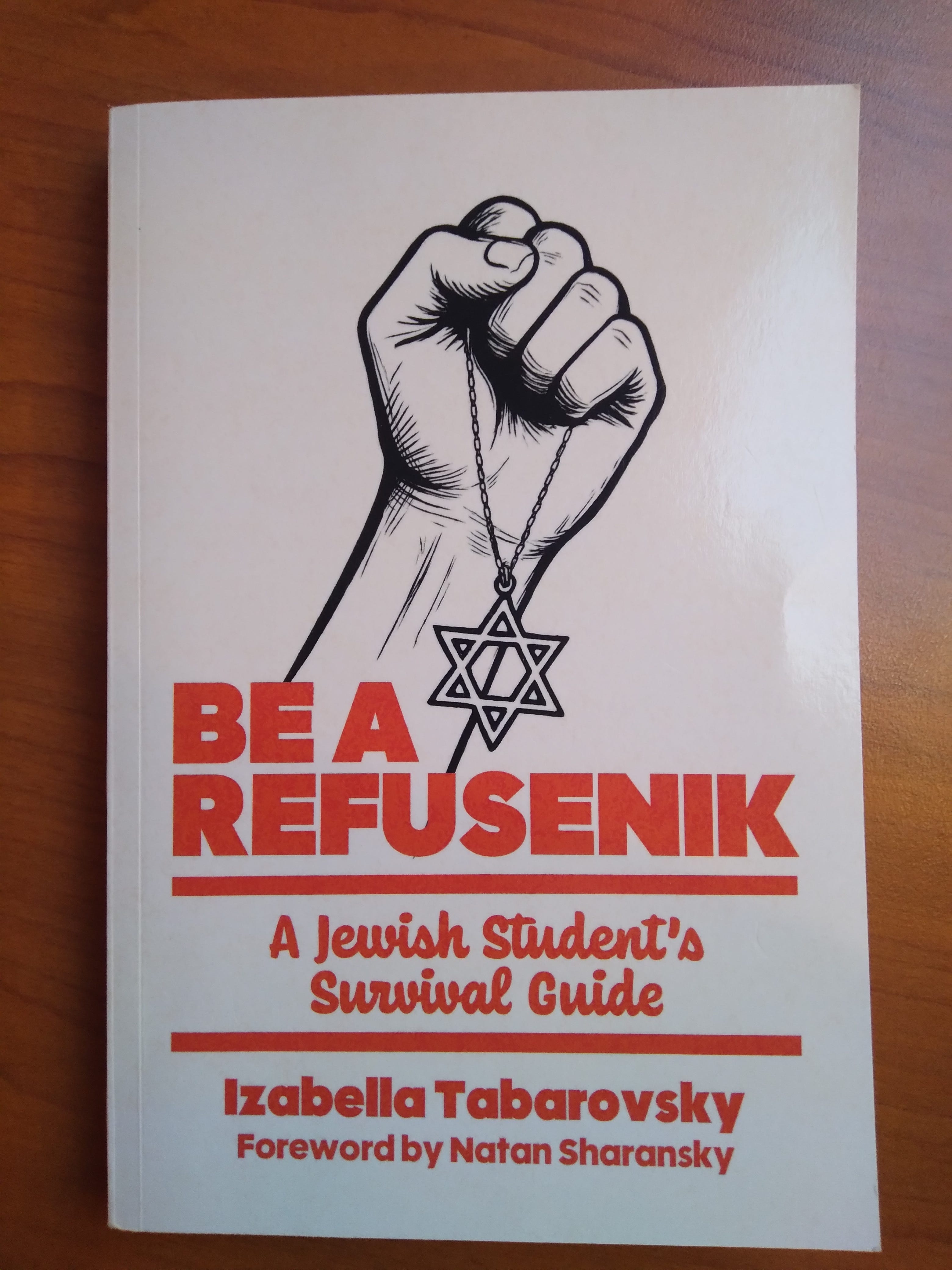
Pairing the stories, Plutarch-style, of Jewish ‘refuseniks’ in the Soviet Union with those of young Jewish leaders on American campuses today, Izabella Tabarovsky has created a powerful resource for resisting antizionist activism. Presented as a “survival guide” for Jewish students, the book reveals the Soviet roots of much current antizionist and antisemitic discourse on the left.
It gives a fascinating account of the refusenik movement, which has largely disappeared from our historical consciousness. The refuseniks were those Soviet Jews who tried to emigrate to Israel and were refused exit visas. Their subsequent defiance of the Soviet authorities gave the term “refusenik” a deeper meaning.
In telling their stories, Tabarovsky illuminates Jewish life in the USSR. She explains how Jews might be able to get by if they abandoned Jewish religion, Jewish culture and Zionist aspirations. Not that all this self-abnegation would provide any guarantee of freedom from anti-Jewish persecution and abuse.
Bolsheviks were opposed to the idea of a separate Jewish identity from the beginning. The assimilationist bargain ‘offered’ to Jews was that if they abandoned Judaism, they could thrive. But despite all the insistence on Jews not constituting a nation – Stalin even wrote an essay on the subject in 1913 – the Soviet attitude was schizophrenic:
The only thing that prevented Soviet Jews from fully assimilating was the state’s insistence on marking their identity as Jewish in their official documents. This practice applied to other ethnic groups as well, but it was only Jews whose official identity – or “nationality,” as it was called – opened them to discrimination, particularly in university admissions and professional careers.
Stalin’s antisemitic campaigns, meanwhile, saw the persecution of some Jews for being Zionists and others for being rootless cosmopolitans. By the time of his death, many Soviet Jews were almost entirely severed from their Jewish identity. Even learning Hebrew was an illicit activity.
If the Six-Day War was a geostrategic setback for the USSR, it was a source of inspiration for some Soviet Jews. So while the Soviet authorities massively ramped up their ‘antizionist’ measures, there was an upsurge in Jews looking to reconnect with their Jewish heritage and seeking permission to leave for Israel. One such Jew was Boris Kochubiyevsky, as the author relates:
In the summer of 1967, collective farms, universities, factories and research institutes across the Soviet Union were ordered to organize meetings, lectures, and rallies to denounce the “Israeli aggression” against the Soviet-backed “peaceful Arab states” – standard language used by Soviet propagandists to describe Israel’s miraculous victory in the Six-Day War. Resolutions condemning Israel were to be passed unanimously to demonstrate to the world that the Soviet public was of one mind on the issue.
Soviet citizens were conditioned to approve any political statement placed before them. But that summer, at a radio factory in Kyiv, somebody went off script. There, a thirty-one-year-old senior engineer named Boris Kochubiyevsky raised his hand and, to the amazement of everyone present, announced: “I want the record to show that I disagree.” Israel, he said, was not the aggressor in this war.
When he refused to retract his words, Kochubiyevsky was pressured out of his job. He applied to emigrate to Israel and was subsequently arrested for speaking at a commemoration of the Nazi massacre at Babi Yar. This was a dissident act because the Soviets forbade Jews to speak of their persecution under the Nazis as being distinct from broader Soviet suffering. After a sham trial, Kochubiyevsky was sentenced to three years in a labour camp.
Before his arrest, he wrote the essay “Why I Am a Zionist”, which was smuggled out of the country and published abroad. Included in Be A Refusenik as an appendix, it is a trenchant piece of writing full of razor-sharp insights:
How is it possible that Jewish boys and girls who know nothing about Jewish culture and language, who are mostly atheists, continue to feel so acutely and be so proud of their national affiliation. The answer is simple: Thanks for that, in large measure, can be given to antisemitism – the new brand of antisemitism that was implanted from above and, by way of camouflage, is called antizionism; and the old antisemitism which is still alive among the more backward sectors of Soviet society. It is precisely this antizionism and antisemitism which prevents us from relaxing and welds us closer together.
The essay also contains the following observation, which is as true now as the day it was written and explains the frenzied demonisation of Israel by certain centrist politicians in countries like Ireland:
In the eyes of many politicians who sense the approach of their political bankruptcy, my people continues to be an ideal candidate for the role of a scapegoat.
As a measure of the historical obscurity into which the refusenik movement has fallen, there is no Wikipedia entry for Boris Kochubiyevsky in any language (at least that I could find).
Yet in their day the refuseniks had major support networks in the United States, and their cause was embraced at the highest levels in Washington. As the author observes, moreover, when Elie Wiesel gave his Nobel Peace Prize acceptance speech, he mentioned refusenik Yosef Begun (whose inspiring story is included in the book) alongside Nelson Mandela and Lech Walesa.
A scholar of Soviet antizionism and contemporary antisemitism, Izabella Tabarovsky has written many much-admired essays. In this, her keenly anticipated debut book, she masterfully negotiates the constraints imposed by her chosen genre and structure. Presenting a great deal of historical information with exceptional clarity, she makes an extremely well-argued case for the defiant embrace of Zionism.
Criticisms are few and trivial. Having a foreword, a prologue and an introduction is perhaps warranted for lengthy tomes, but is overkill for a short book. The summarising sections at the end of chapters, while not contrary to the spirit of the genre, nonetheless give the work a somewhat cramped feel. And although the book design is a deliberate nod to agitprop aesthetics, the occasional printing and editing errors take emulation too far.
One might fear that the pairing of Soviet refuseniks with Jewish activists today might be awkward. However, the author is careful not to equate the respective punishments or risks. And she persuasively shows how the current cohort of Jewish activists truly embody the refusenik spirit. Confronted with a stifling orthodoxy of thought ranged against their identity and abridging their self-determination, they too have reached inside themselves and found great courage.
Furthermore, there are genuine parallels. Take the story of Adela Cojab, who comes from a Syrian-Mexican background and was the first woman in her family to pursue higher education. Studying at NYU was a dream come true for Cojab, and initially she was very happy there. The first sign of trouble occurred during her sophomore year when:
…[s]he wrote a paper on the Syrian Jewish community, analyzing it through Foucault’s concept of a “regime of truth.” Dutifully regurgitating the dogma fed to her in class, she argued that her community sustained its power over members with the help of religious and educational institutions perpetuating its particular, narrow view of the world. The professor loved the essay and offered to help her get it published.
Adela shared the good news with her mom, who asked to read it. This stopped Adela in her tracks. She couldn’t show the essay to her mother. An unmistakable cognitive dissonance suddenly hit her. “I thought: How can I be so proud of something in one setting, yet so ashamed of it in another?” She now admitted to herself that the story she told in the essay wasn’t true.
This chimes with the experience of Natan Sharansky (not in fact the refusenik with whom Cojab is paired, but the book creates a rich web of correspondences). Hauled before a panel of Communist youth organisation leaders, with the purpose of shaming and humiliating him, Sharansky delivered a forthright lecture on modern Jewish history and how Israel was not the aggressor in the Six-Day War. He would later describe this experience as “thrilling and liberating” and as marking “the first time in my life that I publicly said what I believed.”
The stories of the Jewish campus activists are indictments of the universities which failed them. There is the heavy-handed political bias of professors, the open support for terrorist organisations, and the lack of concern for the safety of Jewish students. Most of all, there is the widespread acceptance on the part of university leaders and administrators that Zionism can be legitimately demonised without qualification and that Jewish students who reject the aggressive sloganeering of the antizionist protestors can be subjected to any level of harassment.
But what is this Zionism? In a letter addressed to the community at Columbia University, Elisha Baker and three co-signees boldly declare:
We proudly believe in the Jewish People’s right to self-determination in our historic homeland as a fundamental tenet of our Jewish identity.
Thanks to Tabarovsky’s account of how “Soviet propaganda worked hard to undermine the idea of Jewish peoplehood”, we can see a clear through-line between the ideological repressions of the Soviet state and the hostile attempts by antizionist activists to separate Jews from their identity as a people. Moreover, the book describes how Soviet propagandists inserted bogus smears into Western leftist discourse, such that “[b]y the late 1960s, claims that Israel was committing genocide or was apartheid South Africa’s twin circulated freely.”
And just as Jews might survive in the Soviet Union by discarding parts of their identity, so Jews today are being asked to forfeit central aspects of Judaism to gain the approval of a rabid mob. We need only think of Peter Beinart’s abject apology for speaking at an event in Tel Aviv University to understand where this leads.
It is no coincidence that the leftist academic dogmas of our day tend to rehash old Soviet prejudices using tawdry antizionist slurs, and that left-wing hatred of Israel correlates strongly with communist-adjacent viewpoints. And there is a reason anti-Israel protests are full of the flags of terrorist organisations and foreign powers who seek the demise of the West.
In a powerful conclusion, Izabella Tabarovsky enjoins Jewish students not to sacrifice their interests for another utopian vision, but to lead with their Jewish identity:
Chances are, you will discover – as Shabbos Kestenbaum, Lishi Baker, and other activists profiled here already have – that this path naturally aligns with the core values of American liberal democracy, with its emphasis on individual rights, equality before the law, pluralism, free speech, and constitutional checks and balances.
This echoes Tabarovsky’s earlier observation regarding Natan Sharansky:
In the eyes of the state, Sharansky’s most obvious transgression was his Zionism – the belief that the true home of Jews was Israel and the demand that the state let them go there. But there was something deeper here as well. What the regime couldn’t abide was this twenty-something’s determination to be a free man in a system that rejected the notion of individual liberty.
The refusenik spirit, then, is the dissident spirit of liberty. It is for those who will not be defined, or constrained, by those who hate important parts of their selves. It is the voice of the free-thinking individual who says, “I disagree.” It is the opposite of the masked mob chanting the false slogans of an ideology they do not understand.
Neither is this a coincidence. The culture of Judaism has profoundly shaped the West and its values. This helps account for the singular obsession of anti-liberty ideologies with scouring Judaism from Western culture. The Nazis wanted a Bible without Jews, and the Soviets wanted Jews without Judaism. And today’s antizionists want to erase Jewish history to push their fable of colonialism. As I write, woke-right demagogues, Groypers, leftists and Islamists are circling liberal democracy, looking for signs of weakness. We must refuse to let them pluck out the West’s Judaic heart.
So powerful. I want to memorize the last paragraph by heart and share with everyone I know
Another fantastic piece, Donal.
"Most of all, there is the widespread acceptance on the part of university leaders and administrators that Zionism can be legitimately demonised without qualification..." This particularly resonated. There is effectively one accepted 'truth' that has been carefully curated and manipulated through a highly politicised and biased ecosystem. And what we've witnessed on the streets of Western cities over the past two years is a direct reflection of the overspill of that ecosystem.
I was in Hodges Figgis in Dublin over Christmas, and the section on Middle Eastern History is dominated by anti-Israel polemics and one-sided narrative fetishisation of Palestinians. Good luck to any curious mind in that environment.